
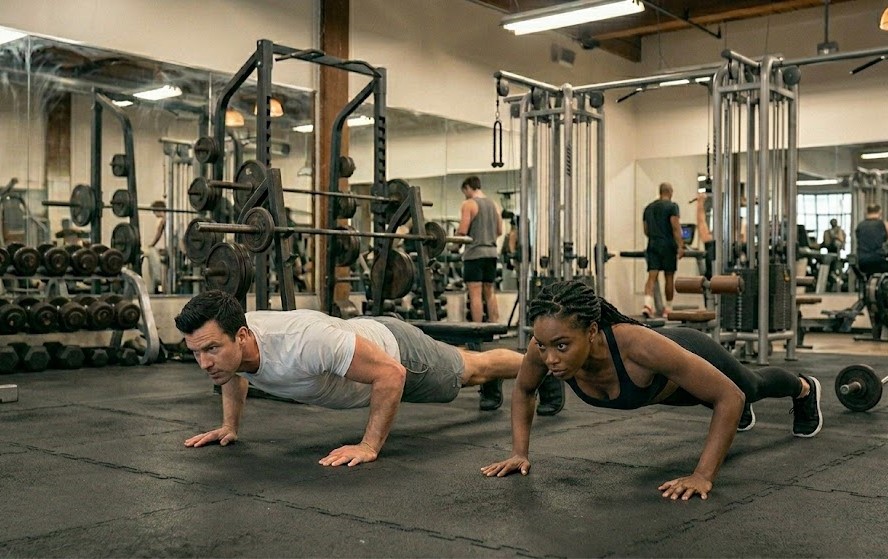
Getting better at pushups requires three things: perfecting your form, practicing 3 to 4 times weekly, and building supporting muscle through bench presses, planks, and rows. Whether you can’t do one pushup yet or want to increase your max reps from 10 to 30, the same principles apply with different starting points.
This guide covers proper form, practice frequency, supporting exercises, and specific progressions for beginners versus intermediate levels. Skip to the section that matches where you are right now.
What Muscles Do Pushups Work
Pushups primarily work your chest and triceps, with your front shoulders assisting. Your core, glutes, and upper back stabilize your body throughout the movement.
Understanding which muscles work hardest based on hand position helps you target weak points and build balanced strength.
| Hand Position | Primary Emphasis | Best For |
| Wide grip | Chest | Building chest size |
| Shoulder-width | Balanced chest/triceps | Standard pushup strength |
| Close grip (diamond) | Triceps | Arm definition |
Wide grip pushups let you descend deeper, which increases chest activation. Close grip pushups keep your elbows tighter to your body, shifting more load to your triceps. Shoulder-width hand placement splits the work evenly between chest and triceps, which makes it the best option for overall pushup strength.
Your core and glutes don’t push you up, but they keep your body rigid during the movement. Weak core means your hips sag, which kills your leverage and makes the pushup significantly harder.
Proper Pushup Form
Perfect form makes every rep more effective and prevents the shoulder pain that comes from sloppy technique.
The 5 non-negotiables:
1. Body position: Create a straight line from your head to your heels. Squeeze your glutes and pull your belly button toward your spine. Your body should feel rigid before you even start the first rep.
2. Hand placement: Position your hands slightly wider than shoulder width with fingers pointing forward or slightly outward. At the bottom of the pushup, your hands should align roughly with your mid-chest.
3. Elbow angle: Keep your elbows at about 45 degrees from your body. Not flared straight out to the sides, not tucked tight against your ribs. Somewhere in between protects your shoulders and maximizes strength.
4. Depth: Lower until your chest nearly touches the ground. Stopping halfway doesn’t build full-range strength. Your shoulders should descend below your elbows at the bottom.
5. Movement control: Take 2 seconds to lower yourself down with control, then push up explosively. Don’t bounce off the floor. Don’t rush the descent.
Common form mistakes that kill your progress:
Your hips sag toward the ground because your core isn’t engaged. Fix this by squeezing your glutes harder and practicing plank holds.
Your elbows flare too wide, which stresses your shoulder joints. Bring them to 45 degrees and you’ll feel immediately stronger.
You’re not going deep enough. Half reps build half the strength. Lower until your chest is one inch from the floor.
You look forward instead of down, which cranks your neck. Keep your head neutral by looking at the ground about 30cm in front of your hands.
Online strength training classes demonstrate proper form with visual cues that help you self-correct without needing a training partner.
How to Get Your First Pushup (If You Can’t Do One Yet)
You need to build both the strength and the movement pattern. These five steps get most people from zero to one clean pushup in 4 to 6 weeks.
Step 1: Master incline pushups
Start with your hands on a kitchen counter and do pushups at that angle. When you can do 3 sets of 12 reps with perfect form, move your hands to something lower like a desk. Progress from desk to chair to a low step until you’re doing pushups with hands just a few inches off the ground.
The lower your hands, the harder the pushup. This gradual progression builds strength while letting you practice the exact movement pattern.
Do 3 sets of 10 to 12 reps at whatever height you can complete them with good form. Train this 3 times per week.
Step 2: Build strength with bench press
You’re effectively lifting 50 to 60% of your bodyweight during a pushup. If you can’t bench press that amount for multiple reps, you don’t have the raw pressing strength needed yet.
Work up to benching half your bodyweight for 8 to 10 clean reps. If you weigh 70kg, aim to bench press 35kg for reps. This builds the chest and tricep strength that transfers directly to pushups.
Do 3 to 4 sets of bench press twice weekly, gradually adding weight as you get stronger.
Step 3: Strengthen your core with planks
Hold a plank in the top pushup position with your arms fully extended for 30 to 60 seconds. Your body should form that same straight line you need during the pushup itself.
If your hips drop during regular pushups, weak core is your limiting factor. Plank holds fix this by teaching you to maintain full-body tension.
Do 3 sets of plank holds, gradually increasing the duration. When 60 seconds feels easy, add a weight plate on your back.
Step 4: Practice negative pushups
Start at the top of the pushup position and lower yourself as slowly as possible. Aim for 5 seconds to reach the ground. Once you’re down, reset to the top position and repeat.
The lowering phase builds tremendous strength because your muscles can handle more load eccentrically than they can concentrically. This is one of the fastest ways to build pushup strength.
Do 5 reps for 3 sets. Rest 2 minutes between sets.
Step 5: Attempt one full pushup daily
Even if you fail, the daily practice develops the movement pattern and the neuromuscular coordination needed. Attempt your full pushup when you’re fresh, not after other exercises have already fatigued you.
Some days you’ll get closer than others. That’s normal. Keep attempting and one day you’ll push all the way up.
Most people following these five steps progress from zero pushups to one clean rep within 4 to 6 weeks. Stick with it.
How to Do MORE Pushups (If You Can Already Do Some)
Once you can do at least one proper pushup, these strategies increase your max reps faster than just grinding out sets randomly.
Test your max weekly
Pick one day each week, preferably Monday, and do one all-out set of pushups with perfect form. The moment your form breaks, stop. Track this number every week to measure progress.
This gives you a baseline to program your training volume for the rest of the week.
Train pushups 3 times per week
Three sessions weekly gives you enough stimulus to improve while allowing recovery between sessions.
Day 1 is your max test. Day 2 is volume work where you do 4 to 5 sets at 70 to 80% of your tested max. Day 3 is variation work using different hand positions or angles.
If your max is 15 pushups, do 4 to 5 sets of 10 to 12 reps on your volume day. This accumulates total reps without going to failure every set, which would trash your recovery.
On variation day, do 3 sets of wide-grip pushups, 3 sets of close-grip pushups, and 3 sets of decline pushups with your feet elevated. Each variation stresses your muscles differently, which prevents adaptation and keeps you progressing.
Use the grease the groove method
Do small sets of pushups throughout the day at about 40 to 50% of your max. If your max is 20, do sets of 8 to 10 every 2 to 3 hours.
This method builds strength through frequent practice without fatiguing your muscles. You’re teaching your nervous system to get more efficient at the movement.
Grease the groove works best on days you’re not doing your formal pushup training. Treat it as extra practice, not a workout.
Add partial reps after failure
When you hit failure on regular pushups, immediately drop to your knees or move to an incline and bang out 5 to 10 more reps. This extends your set and adds volume without letting your form completely fall apart.
The extra volume drives muscle growth and endurance improvements that carry over to your strict pushup performance.
Identify your weak point
Where you fail during the pushup tells you what to train.
If you fail at the bottom and can’t push yourself off the floor, your chest is the limiting factor. Add heavy bench press, dumbbell chest press, and wide-grip pushups to build chest strength.
If you fail near the top and can’t lock out your elbows, your triceps are weak. Add tricep dips, overhead tricep extensions, close-grip bench press, and diamond pushups to build tricep strength.
Targeting your specific weak link accelerates progress faster than just doing more pushups.
Progressive overload with weighted pushups
Once you can do 25+ pushups easily, bodyweight alone doesn’t provide enough resistance to keep building strength. Add a weighted vest or put weight plates in a backpack to increase the difficulty.
Start with 5 to 10 pounds and do sets of 8 to 12 reps. Gradually increase the weight as you get stronger.
Weighted pushups build strength that makes bodyweight pushups feel significantly easier when you test your max.
HIIT training programs often incorporate pushup variations at different tempos and angles, which challenges your muscles in new ways and prevents the plateaus that come from repeating the exact same movement.
Supporting Exercises That Improve Pushups
Pushups alone don’t build the strongest pushups. These supporting exercises develop the strength and stability that carry over directly to better pushup performance.
| Exercise | What It Builds | Sets x Reps |
| Bench press | Pressing strength | 3-4 x 8-10 |
| Plank holds | Core stability | 3 x 45-60 sec |
| Dumbbell rows | Upper back strength | 3 x 10-12 |
| Tricep dips | Lockout strength | 3 x 8-12 |
| Face pulls | Shoulder health | 3 x 15-20 |
Bench press builds the raw pressing power you need. Work up to pressing at least half your bodyweight for multiple reps. This creates the strength foundation that makes bodyweight pushups feel manageable.
Plank holds teach you to maintain full-body tension while your muscles are working. The better you hold a rigid position, the more force you can produce during the pushup. Weak planks equal weak pushups.
Dumbbell rows strengthen your upper back, which stabilizes your shoulder blades during the pushing motion. Strong lats and rhomboids create a solid platform to press from. Weak upper back means unstable pressing, which makes pushups significantly harder.
Tricep dips build the lockout strength you need to finish each rep. The top portion of the pushup is almost entirely triceps work. Stronger triceps mean cleaner lockouts and higher rep counts.
Face pulls keep your shoulders healthy by strengthening the rear delts and upper back muscles that get neglected from too much pressing. Every push needs a pull for balance. Face pulls prevent the shoulder pain that stops pushup progress.
Train these exercises 2 to 3 times per week alongside your pushup practice. They’re not optional extras. They’re the foundation that makes pushup improvement possible.
Upper body strength classes combine pressing and pulling exercises in balanced ratios that support pushup progression without creating the muscle imbalances that lead to injury.
FAQs
How many pushups should I do per day to improve?
Don’t train pushups every day. Do 3 to 4 focused sessions per week with rest days between. Your muscles grow stronger during recovery, not during the workout itself. Daily grinding prevents recovery and leads to plateaus or overtraining. Quality beats quantity.
Why can I bench press but not do pushups?
Bench press doesn’t require core stability or full-body coordination. Pushups demand that you maintain a rigid plank position while pressing, which requires skills bench press doesn’t develop. Practice planks to build core stability and work on the pushup movement pattern specifically. The strength will transfer once you develop the coordination.
How long does it take to get better at pushups?
Beginners see noticeable progress within 2 to 3 weeks of consistent training. Going from zero pushups to your first clean rep takes 4 to 6 weeks for most people. Going from 10 pushups to 30 takes 8 to 12 weeks of consistent training three times weekly. Progress slows as you advance, but it never stops if you keep applying progressive overload.
Should I do pushups every day?
No. Train pushups 3 to 4 times weekly, not daily. Your muscles need 48 hours to recover and rebuild stronger. Training daily prevents this recovery process, which leads to stagnation or regression. Rest days are when you actually get stronger.
What if my wrists hurt during pushups?
Try pushup handles or parallettes, which keep your wrists in a neutral position instead of extended. You can also do pushups on your fists with knuckles down, which eliminates wrist extension entirely. Build wrist strength gradually with wrist curls and wrist mobility exercises. Don’t push through pain.
Do knee pushups help you get better at regular pushups?
Knee pushups build some strength but don’t fully transfer to the movement pattern because they eliminate the full-body tension regular pushups require. Incline pushups work better because you maintain that rigid plank position while reducing the load. Progress from high inclines down to floor level rather than relying on knee pushups.
Conclusion
Getting better at pushups comes down to practicing the movement 3 to 4 times weekly, building supporting strength through bench press and rows, and progressively increasing difficulty through variations or added weight.
If you can’t do one pushup yet, start with incline pushups at counter height and work your way down over 4 to 6 weeks while building pressing strength with bench press and core stability with planks. Practice one full pushup attempt daily even if you fail.
If you’re stuck at a plateau, test your max weekly, train volume work at 70 to 80% of that max, and identify whether your weakness is chest strength or tricep strength based on where you fail during the movement. Target that weak link with specific exercises.
Consistency matters more than intensity. Three quality sessions weekly with proper recovery beats daily grinding that leaves you overtrained and stuck. Programs from online fitness platforms provide structured progression that prevents plateaus while ensuring you’re balancing pushing and pulling exercises properly.